Friday, February 10, 2012

from The Nutcracker Musical Storybook

It's always worth reading what educationist Trevor Cairney has to say about helping children to learn. In this post he recommends seven new children's story smartphone apps.

They all look interesting, but I was taken by the Nutcracker Musical Storybook. It looks a lot of fun, using the original story by E T A Hoffman, and some of the music Tchaikovsky wrote for his famous ballet.

Here is some more information from Cairney's article:
It comes in story or movie mode. Each has a single line of text at the bottom of the screen that presents the simple narrative. In the read-only option the user can control page turning and tap pictures for a number of simple effects (mainly sound and some movement). In the movie mode the story moves automatically from one screen to the next. Both modes make use of segments from the opera. The read only page is controlled from an initial Christmas tree image with numbered baubles allowing different paths through the story. The reader can swipe the pages and interact with a number of visual elements on the way.

The images are delightful and capture the mood of the 19th century winter setting with wonderful variations in colour, light, movement, animated figures (puppet-like), sound and of course Tchaikovsky's wonderful music. The well-known scenes are all there with the 'Waltz of the flowers' and the 'Dance of the Sugar Plum Fairy' brilliant!

It sounds like an app that will help your 4 to 8 year old child to enjoy hearing or reading a story and experience some great music as well.

Wednesday, February 8, 2012

Because it's fun!

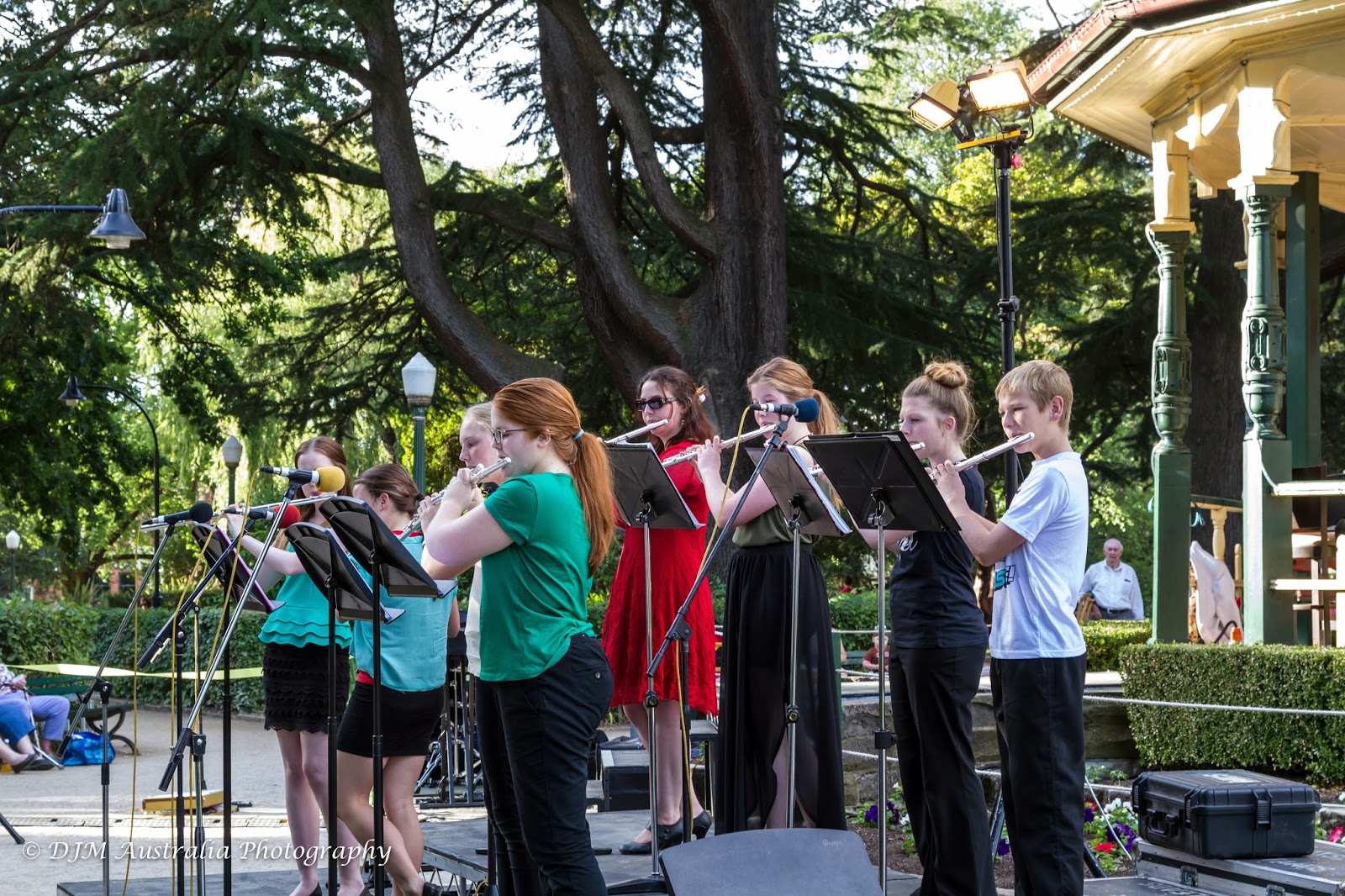
Mitchell Con staff and students making music together

The best reason for making music together is simply that it's fun. But, there are numerous side-benefits:

When the Australian Children's Music Foundation ran a program at Ashley School and Youth Detention Centre in Tasmania, the young people involved enjoyed learning to play guitar and drums, but also developed these qualities in the process:
a developing capacity to work with others
increased confidence and self-esteem
increased capacity to persist at a task
increased skills of self-expression
the development of music as a positive leisure activity
an increased interest in learning how to learn
motivation to share new music skills

Making music together in instrumental music classes in your school or at the Con is so enjoyable,and develops so many other life skills as your child joins in the fun. You can find out more by coming to the conservatorium, on the corner of Russell and George Sts (it's the west wing of Bathurst Court House) or ringing our friendly staff on 6331 6622 during office hours.

Tuesday, February 7, 2012

How will you listen to Armchair Concert?


Will you listen
on your radio on 92.3FM in Bathurst and 94.7 FM in Orange

online at 2MCE.org

or

on the smartphone tunein radio app?

Fortnightly programs presented by Mitchell Conservatorium's Christine Sweeney and David McKay will begin on Monday, 5th March at 1.30 PM. The programs will include some of the great music played in recent Mitchell Conservatorium concerts

Saturday, February 4, 2012

Teaching your child to love language


Would you like to give your child a priceless gift? You can do it quite inexpensively. All it will cost is your time and maybe a few dollars for a poetry book (though there is plenty of poetry for kids available free of charge on the internet).

Children love the rhythm, repetition and rhyme that we find in poetry. Reading a poem aloud is a great experience and it is even more enjoyable when you have someone to share it with.

You will notice that poetry is incorporated into Early Childhood Music classes at Mitchell Conservatorium, because it is so closely associated with music-making.

Jim Haynes' Big Book of Verse For Aussie Kids is a great collection of old and new poems. There are many old favourites here, but also lots of new, entertaining poems.

My copy does not have an index, but the editor (and author of some of the poems) has provided one on his website.

Here are a couple of my favourites from the book:
A Feather-Brained Fiddler
A feather-brained fiddler named Rouse
Sat alone at the top of his house
When attacked by some crows
He sedately arose
And played some selections from Strauss

Why?
Why does a clock face not have a nose?
Why do foothills not have toes?
Do all-day laundries close at night?
Will the teeth on a garden rake ever bite?
Why can't a needle wink its eye?
why can't the wings of a building fly?
What is the sound of a gum tree's bark?
Can you leave your car in a national park?

What are some of your favourite poems to read to your children? Can you suggest any more sites or books where we can find these poems?

Tuesday, January 31, 2012

How to make it difficult for your child to practise

Bryn White, in 2011 scholarship concert

Here is some more practical advice from Cynthia Richards' book How to get your child to practise ... without resorting to violence.

The earlier article gave suggestions for making it easy for your child to practise.
Here are twelve stumbling blocks which can make things harder than they need to be:

1 Indifferent home environment
2 Faulty teacher-child relationship
3 Lack of maturity and commitment in the child
4 The wrong instrument
5 Unfavourable practice conditions
6 Bad memories
7 Peer pressure not to practise
8 Not proficient enough to be competitive
9 Too many conflicting interests
10 Sibling rivalry
11 Competitive feelings with a parent
12 Communications

Some of these things can be tinkered with, to give your child every opportunity to enjoy practising. Can you see something you could do that might help your budding musician?

What would you add to the list?

Tuesday, January 24, 2012

Helping your children to love reading.

Two cousins ready to start school, one almost 6, one just turned 5

If you want your children to love reading and enjoy learning, you will find Trevor Cairney's Literacy, families and learning to be a great source for helping you to achieve this objective.

His article Starting school: is there a best age? is great advice for those who are thinking about whether their children should begin school in 2013 or 2014, but is probably too late for those whose children are beginning school in a few days' time.

But there is still plenty in this article to interest parents of brand new schoolchildren.

And all of this has relevance to budding musicians. You don't need to be able to read to enjoy and play music, especially when you are a toddler and participating in Early Childhood Music classes.

But good reading skills are very helpful for primary school children having individual instrumental or vocal lessons.

Friday, January 20, 2012

Encouraging your beginning musician

Cynthia Richards' advice is great for parents of primary school children, but most of it would not apply to toddlers. Four of her suggestions would be equally applicable to beginners, though:

1. Start early
2. Enjoy your children's music
3. Praise them for their successes
4. Focus your efforts on getting your child hooked on music.